Andrew Hessler2026-11-08T21:40:41.781261387+00:00enAndrew HesslerPlease, I beg you, we need to stop using Stored Procedures (from applications)https://heffree.dev/blog/no-more-sprocs.htmlAndrew Hessler2026-08-30T00:00:00+00:002026-08-30T00:00:00+00:002026-08-30 | programming databases
Please, I beg you, we need to stop using Stored Procedures (from applications)
Please, application developer, I beg you, stop allowing reliance on Stored Procedures to enter your codebase.
Please, application developer, I beg you, learn some SQL!
Please, database administrator, I beg you, stop using Stored Procedures as a cudgel to compensate for your application devs.
Please, database administrator, I beg you, guide your devs when it comes to SQL, indexes, query plans,
transactions, isolation levels, parameterized queries, parameter sniffing, sargability, profiling, bookmark lookups, schema design, normal forms, denormalization,
cardinality, B(+)-trees, WAL, the holy trinity of CPU/Log IO/Data IO, and everything else my DBA has yet to teach me.Or that I failed to mention... Also, I'm not incapable of learning on my own and I swear I do it. I just always learn better when a DBA tells me something 😅
- Me, for the last 5 years
Alright, great, now that that's out of the way I can go back to calling them sprocs. Listen, we need to talk,Or I need to talk at you I guess. You can respond at andrew@heffree.dev
I don't know if it's just a thing at my work — and in that case I guess I'm
outing us a bit — but I'm seeing far too many (i.e. any at all) applications calling out to a sproc. Thankfully,
this (suspiciously new) Reddit user
mentioned it as well,
so I must not be alone!
I've felt this way for a while, but seeing this (plus recent events at work) spurred me to make a quick post going over it.
My hope is to cement such an all-encompassing reasoning here in this post that there's no room for argument, only disagreement on the final judgement.
Luckily, there really isn't much to it, honest.
Forgive me for this being so SQL Server centric, but it doesn't change the thrust that if you own an application, you should do what you can to colocate your DB access logic with your app logic.
What do you want out of your DBMS?
When we make a request to a database there two major sproc benefits we care about replicating.
The first is plan caching. When you make a database query, your DBMS will use the statistics of your data to
calculate the optimal way to gather that data. This is an expensive process, so ideally this is a rare operation.
The second is parameterized queries. Parameterized queries allow us to inform the DBMS of the types of our inputs, they let us separate the data from the logic.
Conveniently, parameterized queries also help us reuse query plans from the plan cache. If I send SELECT 1 FROM my_table WHERE code = 'SUPER_COOL_GUY' and then I send
SELECT 1 FROM my_table WHERE code = 'SUPER_UNCOOL_GUY', that's two separate query plans, that's the evil we call a dynamic query.Typically, dynamic queries are seen when the structure of the query changes a bunch, but this counts!
However, if I send:
-- Hey, look, a stored procedure, well dammit... -- we can rely on this one, that's fineEXEC sp_executesqlN'SELECT 1 FROM my_table WHERE code = @code',N'@code NVARCHAR(50)',@code = N'SUPER_MEH_GUY'
Now we have a parameterized query where we can send anything in for code and it'll use the same query plan over and over, without the DBMS having to recalculate.That is — as long as the parameter hasn't been Parameter Sensitive Plan
sniffed and deemed in need of a separate query plan, but that'd happen with sprocs too. And is also super SQL Server specific.
So what does a stored procedure get us?
Absolutely nothing!
Well, I mean, headache for one. But whether you execute your SQL as above or call into a sproc, your DBMS is going to treat it just the same.
It will handle binding your inputs to your parameters,
it will generate a query plan on first execution (yup, not precomputed for sprocs), and it will reuse the query plan on seeing the same query body. We get all the same benefits.
What other fun side effects do we get from using a sproc? Well, our application code and DB access are separately versioned,
our sprocs can change right under our feet from aberrant (i.e. extremely rare, insane) DBAs, we have to deploy migrations to update our queries, and we have to run diff migration_for_my_sproc migration_for_my_sproc_n
to see how things changed. And don't even get me started on rollbacks, oh my goodness... when's the last time you initiated a database rollback after a deploy?
For my team, never, we actually can't because it's too convoluted and dangerous so we haven't even introduced the means.
On the other hand, if we own our queries — well, we get to own our queries, that's awesome! We get our database access lockstep versioned with our application logic.
We get to take advantage of actual-version-control-without-having-a-file-that-just-holds-the-contents-of-a-sproc-that-we-try-to-remember-to-update-every-time-we-write-a-migration-to-deploy
the-new-version-of-a-sproc-that-invariably-gets-out-of-sync-because-no-one-made-a-CI-check-to-see-if-the-migration-you-just-deployed-also-made-sure-to-update-the-redundant-file-you-track
just-for-version-control... *heavy breathing* And also, we can rollback our application and our queries!
After all that, I can only assume if you still want a stored procedure you just really want your DBAs to own your SQL for some reason (those reasons exist).
Thank them for so kindly being on-call with you.
How should app devs interact with their DBs?
Yeah, that's right, your DB, have some pride, gall darn it.Assuming you've opted into "banning" sprocs from your application at this point, otherwise put your pride where you will.
Now that we've accepted responsibility for our database access, it's important we be upstanding coworkers and help lighten the load as much as possible for our DBAs.
You won't avoid every mistake, DBs are hard, DBAs are smart. But some basics can get you far, I'll walk you through some of the big ones.Some of this might be pretty obvious, but I've been seeing a lot of people saying obvious things are great things to write about :D
Network Requests
First and foremost, as an application dev you should know that network requests are our bane, you'll almost never do anything slower. Provided you're not on-prem, that DB... well, it ain't close,
not even to your apps also running in the cloud. It's another network hop away, persistent connection be damned — at least it's probably in the same datacenter, probably.
So we want to interact with our DB in as few requests as possible. Most DBs will have an option to return the values from the row you just updated or inserted.
If not, do an upsert pattern bundled with a SELECT. I can't explain the ins-and-outs/hows-and-whys of every DB, but every DB will support you not making a bunch of separate
requests to achieve your goals.
Indexes
Indexes, use them. If you're using a column in your query's predicate (the WHERE), you're gonna want an index on that column — most likely a composite index on the collection of columns.
It'll be a cold day in hell the day you don't want an index on a predicate — obviously hyperbole, but very very often it's true.
More specifically, indexes are more effective the greater the cardinality of a column.
A boolean or bit has a cardinality of 2 (unless it's also nullable, then 3), so it can only really be separated into two "buckets". The reason you wouldn't want an index is because it impacts
the speed of writing to your DB, but this is almost always so minuscule that it's not worth consideration until you're seeing issues.
You shouldn't opt for the opposite, i.e. not indexing until you see issues. As always, profile, benchmark, analyze.
Your DBMS should also support something called covering indexes (usually specified by INCLUDEs).
These are a bit more situational in my experience, but if you need to speed up reads and don't have a ton of writes going on,
you can include the data your queries request in the index.
ORMs
ORMs are... okay. They're good for quick little queries on sprouting applications. You should make sure you're not pulling full "Entities" if you don't need all the data, every ORM should
have an option to select specific columns. This subset of columns is called a "projection".
You should also always do your due diligence and view the exact queries your ORM is sending to the DB,
they'll typically have an option to turn on query logging. ORMs can do surprisingly many queries in the
background, for example: a findOne in TypeORM for SQL Server will do two separate SELECTs, a save will do a SELECT and then an INSERT or UPDATE.
The infamous N + 1 (or more aptly, 1 + N antipattern) is something much less achievable with your average SQL query and only really a mistake you'll make relying on an ORM, with something like
fetchTables().forEach((table) => fetchTableLegs(table)).
Cartesian Explosions
Last big one is 💥💥CARTESIAN EXPLOSIONS💥💥. Generally speaking, joining tables in SQL or through your ORM is going to be faster
than separate SELECT statements for related rows. So:
SELECT *FROM tablesWHERE id = 3SELECT *FROM table_legsWHERE table_id = 3-- vsSELECT * FROM tables tINNER JOIN table_legs tl ON t.id = tl.table_idWHERE t.id = 3
Assuming the table has four table legs, we'd end up returning 4 rows.
Now that INNER JOIN actually doesn't have the same functionality as the above two queries would.
If that table has no legs it unfortunately wouldn't be returned from the query. So instead, we'd
likely want to use a LEFT JOIN, provided we still want to report the table exists and is tragically legless.
Let's say we also want to pull all coasters that sit on the table.
This is where the dangers of a potential 💥💥CARTESIAN EXPLOSION💥💥 come in, e.g.:
SELECT * FROM tables tLEFT JOIN table_legs tl ON t.id = tl.table_idLEFT JOIN table_coasters tc ON t.id = tc.table_idWHERE t.id = 3
Now assuming four legs and four coasters, we'd end up with 1 (T) X 4 (TL) X 4 (TC), 16 rows. And that's a 💥💥CARTESIAN EXPLOSION💥💥! If you're entering this territory, think about how
"bounded" your relations are. Presumably the number of legs are bounded, I couldn't find a Guinness world record for the table with the most legs, but surely it's like 100. On
the other hand we could stack coasters to the moon, so that value is "unbounded", we should probably break it out into a separate SELECT so our main query can continue to pull in table values.Yes, I realize using tables as my example is a teensy bit confusing when discussing databases...
Somewhat related, generally duplicating data onto rows like this isn't the end of the world, you sacrifice a little memory for speed. However, if you have a really heavy column, consider
grabbing it separately.
Grab Bag (Dynamic Queries/TVPs/Conversions/Filtered Indexes)
Alright, lightning round.
Dynamic Queries
As mentioned above, a query plan is cached against the body of a query, the literal text of it. If you're conditionally adding different fields to SELECT on,
JOINing additional tables, or modifying your predicate, you're generating new query plans.
Your DBMS can likely support a small range of these, but if you start generating a lot of them, you will completely monopolize the database CPU.
TVPs
Leading in from above, if your query has a varying number of parameters in the predicate, e.g.:
SELECT *FROM tablesWHERE id IN (@1, @2, @3)-- and then SELECT *FROM tablesWHERE id IN (@1, @2, @3, @4, @5)
Each query with N parameters will be a different query plan, TVPs can help you reuse the same query plan regardless of the number of parameters.
You'll need a type stored as part of your schema to allow passing in a TVP, e.g.:
CREATE TYPE dbo.IdList AS TABLE (id INT PRIMARY KEY)
Then consult your ORM or DB driver SDK documentation to see how to supply the TVP to a given (parameterized) query:
SELECT t.*FROM tables tINNER JOIN @TVP tvp ON tvp.id = t.id-- or SELECT *FROM tables tWHERE t.id IN (SELECT tvp.id FROM @TVP tvp)
Multiple query plans aren't the end of the world, so this can be used as a last resort if you're seeing issues.
Type Conversions
One especially dangerous hiccup to call out when owning your queries is to make sure your inputs are correctly declaring themselves. Sometimes your ORM
will incorrectly default types being passed to your parameterized queries, e.g.:
EXEC sp_executesqlN'SELECT 1 FROM my_table WHERE code = @code',N'@code NVARCHAR(50)',@code = N'SUPER_MEH_GUY'
If our code column is defined as a VARCHAR, NVARCHAR has type precedence, so you're going to get an implicit conversion for every row
you check, converting each code to an NVARCHAR for comparison.
Filtered Indexes
Last little fun thing, filtered indexes. Deploying indexes can be an extremely heavy and time-consuming process, especially while the DB is under load. You can
greatly reduce the amount of time it takes to build an index by narrowing the index to a subset of values. This is called a filtered index.
Index creation is so time consuming largely due to actually writing the index, it's easy to check the values. If you don't need to query on every potential value of a column, consider
a filtered index, e.g.:
CREATE NONCLUSTERED INDEX ix_tables_in_stockON tables (id)WHERE in_stock = 1;
Great time to point out, to actually use this index you DO NOT want to parameterize the input. It is not variable, it does not need to be sanitized, you would hardcode it into the query:
Okay, that's it. I figured if I was gonna rant a bit I should hand out some tools to get started. Hopefully, this is useful to you if you've felt the pain of managing sprocs.
There are certainly uses for stored procedures, it should just be more of an exception than the ultimate form of supporting applications. Sometimes you'll have no choice for security reasons,
that'll happen and it is what it is. But if you have the option, at the very least, please, don't fall for the "sprocs are more performant" line.
There's a lot more to learn; read query plans, profile, have fun, be safe!I'm re-aware of Jeff Atwood's post from 2004(!), I'm sure there are more, but it's still happening!
]]>Moved Off of Githubhttps://heffree.dev/blog/moved-off-github.htmlAndrew Hessler2026-08-06T00:00:00+00:002026-08-06T00:00:00+00:00feels good for some reason2026-08-06 | programming
Moved Off of Github
Just a quick check-in. Been doing a lot of "digital hippie" things. Joined Mastodon, hanging out in the Lobste.rs IRC a lot, getting my blog posts
delivered by (news)boat, and now I've moved (or deleted) all of my repos off of Github. Where'd they go? To my own forgejo instance hosted on
the same linode instance that hosts everything else. I'm waiting for the day I stop renting to look into localI'm not sure "local" is the proper way to distinguish it, but I think even if you're using a VPS it's still a form of self-hosting, just not
heart and soul. self-hosting.
I still need my Github for work and it's not terrible to at least have the foothold. I'll probably update my user README to point to my projects on
forgejo. Plus there might still be other projects on Github I'm interested in contributing to some day. Also need to update my personal site to not
point to Github anymore either. Kind of want to make a whole more involved projects page, but probably the list of repos on forgejo is good enough.
We'll see.
Anyway, feels pretty good, kind of feels like paying off debt in a way. Weight off my shoulders, I own my shit, at least a little more than I
did before.
I also added a Gallery page for any drawings I feel like sharing. Looking forward to continuing to fill it up!
]]>Reference Image Playerhttps://heffree.dev/blog/reference-image-player.htmlAndrew Hessler2026-07-27T00:00:00+00:002026-07-27T00:00:00+00:00I made an app for my own use, Go Figure!2026-07-27 | programming drawing
Reference Image Player
Wow, I'm pretty excited! I've finally made an application
for my own use after trying out a couple others — with which I was ultimately unhappy.
I've started studying drawing recently and as part of my practice I've been doing quick figure drawings for 30 minutes every morning.
Previously — before making my awesome app — I was using a combination of web apps to source enough variety in reference images. I really liked
the experience provided by Line of Action and would be disappointed in the lost QoL whenever switching
to another app to get access to more images. In addition to Line of Action, the other reference image playerI really don't know what to call this category of application, so I've settled on "reference image players". Though, I suppose
those smart frames that cycle images kind of fit the bill as well... I enjoyed enough to keep
using was Quickposes, though it lacked some nice features LoA had e.g.
sounds at specific intervals or specifying how many images you wanted in a session.
The Killer Features
To be honest, I feel a bit silly. It's not a groundbreaking application and mine isn't even especially feature rich, but it just works
exactly how I want it to. I have a couple other utilities and web apps that I've made and still use regularly,
but never something I felt would be actually valuableOr frankly even applicable, as most things I've made recently aren't generalizable to an audience and pretty specific to my workflows and setup.
I'm not gonna have someone self-host my all-in-one media/exercise/family messaging/shopping/etc. app. to others — and I can definitely see another aspiring artist using this app.
The first feature I wanted most was the ability to review! My god, you'd think that'd be table stakes, but with all the licensing and
cloud hosting of the images, you either:
CAN'T REVIEW THE IMAGE BECAUSE IT'S NOT LICENSED FOR VIEWING (unless you random upon it through the image roulette)
Or can't review the image because you closed the page and it would be prohibitive for the website to keep history for all their users,
for all their images, not to mention they might shed images and wouldn't be able to show them to you anymore.
This was especially frustrating because I like to review my practice with my wife, so to ensure I'd always be able to show her the references
I just ended up recording my screen each time with OBS. Not the worst thing, but certainly silly.
Now I have a button that, no matter how many or how varied my sessions areLet's be honest, I could actually hardcode my standard session, I have yet to deviate lol.
5 1-minutes, 3 3-minutes, 2 5-minutes., I can just hit "Review Day"
and walk through each reference image for the day with my wife!
To make the history and licensing stuff easier, the application is completely local and uses local images, so it's BYOIAlso as part of this I did end up making a bit of an image web scraper and now have around 40k reference images locally.
All were technically paid for, they just had really inconvenient or sometimes impossible download processes even
when explicitly offering downloads.. You could see that
as a feature, but really just feels like a different path. I can certainly compare the features of my reference image player to others, but
I'm not offering anywhere near the service they doMaybe they'd let me make players for them?.
But along those same lines, some features just aren't possible for them to implement BECAUSE of the service they provide.
Of course the best feature is that I can add any feature that I want. It is nice to be in control of your software.
The End
That's really all I got. Tauri stack, React as usual (can't help myself). You can see the demo on Github if you're interested.
Oh, also as part of this I joined the Apple Developer Program so I could sign my Mac version. So maybe some mobile apps in my future?
I'm just very grateful that I've had this experience.
I feel like it's a bit of a plateau I've overcome in terms of software development. I've always wanted to make
something someone else could useMind you, there are no other users of my app afaik. I did share it on Reddit and it got some upvotes,
but I know someone <i>could</i> install it and use it with little resistance..
I've also tried repeatedly to follow the advice that I should make things I want to use, but I feel like in the past I've been so set on
making something, that I never took time to actually cultivate hobbies or interests that could benefit from being able to make software.
Then I stopped looking and the opportunity and desire just landed in my lap! I imagine now that I've tread the path it'll be easier
to walk down in the future, though I'll continue to avoid searching.
Over the last 10 years, I've felt my anxiety growing and growing, to a degree I thought insurmountable. There's a meme that men will do anything but go to therapy and I apparently chose a short jaunt with philosophy as a substitute. That's convenient, though, because the idea of philosophy as therapy is apparently fairly common.
I mentioned in RSI and SICP that I had started reading "How to Stop Worrying and Start Living" by Dale Carnegie. That led me to reading "Meditations" and learning about Stoicism, then its counterpart Epicureanism. As my Youtube started recommending me more and more philosophy, I eventually landed in the area of Nihilism and its answers of Existentialism and Absurdism.
I intend for this post to be a commitment that I'll no longer dwell on what my life will amount to, I've found my answer in Absurdism. It will simply amount to nothing, I'm essentially here as a piece of the universe experiencing itself and that's the extent of it. I wanted to write this post, 1. because I feel this has been an especially transformative time for me, but 2. I still find myself occasionally thinking about if I'm doing the right thing, if what I'm doing at this very moment will set me up for success, thus the commitment part.
Anxiety through my ages
I've been struggling with anxiety for a while without really realizing it. I remember constantly in high school and college, before any big speech or presentation I'd have to run to the bathroom and shit myself. So great. Luckily, the biggest stressor was knowing that would happen and worrying it wouldn't happen soon enough; once it was over the actual event felt much more manageable.
Then when I moved to Seattle, my wife suggested I should see someone because I was constantly spacing out instead of following our conversation. She assumed this was ADHD, but the behavioral therapist I saw (oh hey, I did kind of go to therapy a bit) said that a lot of my symptoms sounded much more like anxiety. I started crying as she went over the symptoms. I had a very similar reaction when I saw this goofy ass SNL skit. We're not alone. It felt like such a relief to know what I was dealing with and for the most part I feel like that was all I needed. Now that I knew what the problem was, I felt I could just compensate.
That worked pretty well for a while. Then I started spiraling about our lack of support system in Washington (we had moved out of Seattle to Bellingham at this point). I worried what would happen if I lost my job and we had no family to rely on, if we'd have to pick up and move home anyway to be able to survive in that scenario. So, we ended up moving back to Minnesota, driving with 3 animals across 3 states to get back.
This also helped a lot. It was weird going back after so long with so much changing, it was hard to get back into the groove of things, but we had our immediate family to rely on again. The only problem was I still felt a lot of worry about if I happened to lose my job. I absolutely dreaded the interview process during this time and I feared it as an impossible uphill battle that we'd surely be destitute. So, I did a bunch of things to try to alleviate that anxiety. I made an effort to fix my ergonomics to ensure the health of my hands: I tried a few different ergonomic keyboards, learned to type using Colemak, and now regularly use my standing desk so my hands can drop to my sides. I started using Neovim to try and learn my tools inside out. I've read around 20 textbooks in the past couple years, endless blog posts and talks on the art/craft of software engineering, and I still have a deep backlog to get to. I also started using Rust since I see it as an important part of the future of programming.
After all this, I felt confident in my abilities... I'm at least able to recognize that I've put in a lot of work and I should be proud of it and I should be confident. That helps me be confident in my abilities sometimes. The next thing to do was to try and secure a financial future for my wife-and-I and to get a yard for my dog. This is the only thing I feel I've really "failed" at, but really it just didn't happen as immediately as I hoped. I do think my dog will have a yard some day. I don't know if we'll ever feel secure in our finances. Money is mostly fake anyway, all of it can just disappear so probably best not to put your faith in it protecting you.
Anyway, I tried to secure this financial future in a number of ways. I've done interview prep, I've done leetcode, I've thought about what the hell kind of SaaS I should make or what open source tool I could work on to build a network and get name recognition. Ultimately, I think the prevailing wisdom is that going into something simply for the money is less likely to be successful than something you love doing. Either way, it's not what I want to be doing, it's something I felt I had to do. I'm ready to stop.
Hopefully it's clear that I've repeatedly attempted to tackle what I viewed as the catalysts of my anxiety. Which is where Absurdism comes in.
You can do anything
I like to sum up Absurdism as "You can do anything," but that can be pretty dangerously misconstrued. It's definitely not that you should do anything. But if you wanted to, you certainly can quit your job and go live in a tent in the woods. There may be forces that work against you doing this, such as a desire to live with your family, inside a house, among society, but you definitely could do it. I think another way to put it is "You might be dead tomorrow." This is also reminiscent of "day-tight compartments", essentially why stress about yesterday, it's gone and over. Why stress about tomorrow, you might not even see it. What you do have is today. And when you no longer have today, you have nothing, you are aware of nothing, everything in your past meant nothing because you are not there to give it any sort of purpose at all. Instead you can revel in the revolt of living, your place as the universe experiencing itself.
For me this has led to a much more local change of no longer worrying about my financial future. I'll still certainly work towards my goals, but why stress about them. This has given me the room to consider that I may spend an inordinate amount of time on trying to secure that financial future, such as making a badass SaaS, but never get to enjoy the outcome. So instead I'll do what I want in my free time, I already work to make a living. There's a small hope inside me that the things I am doing in my free time could lead to something more, but it isn't what drives me doing those things.
That's pretty much where I'm at. There's no need to question what I'm doing any further than "Do I enjoy what I'm doing right now?" Whether that be scrolling Reddit or building a little robot.
We can refine that a bit, just because I might be dead tomorrow, I still don't want to be completely shortsighted. Epicureanism and Stoicism offer some ideas for living pragmatically. Epicureanism points at living life seeking happiness, but also recognizes at some points that you should be willing to suffer some pain for the happiness of the future. This has led me to exercising more regularly, for the happiness of my health. I like to think of Stoicism as saying we can't change all around us, sometimes we just have to accept the world and live with it as it is. This has helped me stop stressing about the decisions other people make and to try and adapt to the changes in the world.
This has shaped my philosophical outlook. Now I want to stop thinking about philosophy and just live. That may be impossible. I'm sure I'll want to mention it occasionally and reaffirm it or even use it to describe my motivation for something. But I definitely want it to take a backseat to what I want to focus on.
What are those things? I've decided to take up drawing, I've been learning intently since the beginning of April. I'll have to rework my site a bit so I can have a little gallery. And then also Timewaste, my little game project that's a literal symbol of my Absurdist revolt. And then I just have an interest engaging with culture and the zeitgeist in general.
]]>I Broke My Wristhttps://heffree.dev/blog/broken-wrist.htmlAndrew Hessler2026-03-06T00:00:00+00:002026-03-06T00:00:00+00:00a couple weeks ago, not today2026-03-06 | misc
I Broke My Wrist
I'm going to keep this really short, already been overusing my newfound typing abilities today, but I do just want to make a record of it.
I live in Minnesota, icy out in the winter and whatnot. On February 20th — so close to the end of winter — I slipped and caught myself on my wrist and broke my radius and ulna.
Basically the roads in the townhome development I live in are an ice rink and they just leave it that way.
I stopped to breathe in the air, took a step, slipped and tried to catch myself from landing square on my back.
Today, 14 days after my injury, I got my more permanent splint and can finally type again — halle-fricken-lujah. It hasn't been terrible, the pain has been super manageable and I've
never actually broken a bone before, so it was at least a bucket list activity (also never had surgery before so that was cool). I took the time to binge-watch Silicon Valley (at first it induced some anxiety, but I've enjoyed it overall lol)
and read part 1 of Gödel, Escher, Bach. I get to head back to work on Monday!
Before my injury, I had some updates I wanted to post regarding Timewaste, so hoping to get around to that shortly, but for now I'll just settle for this small little post.
]]>RSI and SICPhttps://heffree.dev/blog/rsi-and-sicp.htmlAndrew Hessler2026-01-22T00:00:00+00:002026-01-22T00:00:00+00:00pain in my forearms, gain in my brain2026-01-22 | llm rsi sicp philosophy typing
RSI and SICP
I don't know why I'm combining these into one post, but they're happening concurrently and they're both acronyms so let's just roll with it.
RSI
One thing about me is I like typing (neovim btw). I'm not amazing at it, there are people who type at speeds that absolutely floor me, but I love doing it and working on it.
Ergonomics
On July 12th 2024, I started learning the alternative keyboard layout Colemak in an attempt to "ensure the health of my hands" (and somewhat to relearn touch typing from scratch).
I used a few different resources, typing constantly every day, learning my n-grams, and eventually pushing my WPM up.
I was doing most of this practice on my — looking at my email, apparently new at this time — laptop from System76, so just a standard laptop keyboard.
I actually found a blog post in my notes that I don't think I ever posted, written on August 12th, a month later.
I intended to post it on Reddit, but I think I figured no one would really care, haha.
I put in my notes: "Decided to give up on [[Typing Blog Post]] because it's mostly just bragging".
And now I've actually started a blog, crazy. As far as I can tell, the post is actually complete, maybe I'll post it on here.
Anyway, it mentions that my hands were sore during the transition, especially my pinkies, but it mostly cleared up within the month.
But I did have some concerns that the switch would be long-term detrimental for my hands. As far as I can tell though, it wasn't, and my hands went back to normal.
On September 6th 2024, I got my first ergonomic keyboard, the ZSA Moonlander. It took some getting used to and I took a small hit to my typing speed.
But after a couple days of practice I was back up to speed — my new slow Colemak speed. I had some additional pain with the transition, but that seemed to subside as well.
I wouldn't complain about fatigue or soreness in my hands until September of 2025.
I think somewhere around this point I started having really bad form with my Moonlander.
My hands had an insane positive tilt, I wasn't keeping them neutral at all and did a decent amount of damage to my hands.
It got really bad in early December, to the point that I started looking for an alternative keyboard to force me to correct my form once I started assuming it was the tilt's fault.
I landed on the Glove80. Mostly because I thought my body preferred negative tilt and that would just fix everything.
On December 5th 2025, I received my Glove80 and got to setting it up. I started using my thumbs for backspace and shift. It felt absolutely amazing to type on and...
I overdid it. I typed so much I actually ended up fully injuring my hands and had to completely scale back keyboard usage.
Specifically, it felt like the base of my thumb was bruised, the back of my forearms were in a lot of pain,
and I think I was also feeling what's called tennis elbow?
Recovering
For work I switched over to doing everything with voice dictation and LLMs.
I've gotten so many benefits from this experience of making my hands, essentially, temporarily useless. Some among them being:
Voice dictation is pretty convenient and I really like VoiceInk, it's so snappy and local.
Also, Opus 4.5 is a beast and actually does what I tell it unlike so many other LLMs that bring with them so much noise.
As far as I can tell this is an acute injury, nothing chronic. I met with a physical therapist to get a plan together and learn more.
I was already working on rehauling my diet-and-exercise and had been stretching and building my forearms.
I've been hearing plenty of RSI war stories that are resolved by diet-and-exercise and I'm definitely starting to believe it.
Something else that seems pivotally important to recovery is some amount of optimism. Concern is good, worry is unproductive.
I eventually picked up "How to Stop Worrying and Start Living"
by Dale Carnegie while reading random posts on Eli Bendersky's blog where he recommended it.
Serendipitously, I only found his blog because I was looking up others' experiences with SICP.
Not often I get to use that word and I probably still shouldn't because it just sounds like I'm using word of the day toilet paper, oh well.
This book improved my peace of mind tenfold.
I've found I'm pretty susceptible to the placebo effect, most of my illnesses are immediately more manageable the moment I take medicine. I don't want to be too
self-evaluating here, but all this to say the book advised doing things that I knew to be helpful, but wasn't practicing to solve my immediate problems. The moment
I started practicing them, I felt relief. I'm not cured of my worry or anything, but I see a path forward to fight it — or maybe accept it?
My physical therapist also recommended a book, "The Pain Management Workbook" by Rachel Zoffness,
which basically reinforces the idea that your body affects your mind affects your environment affects your body. The biopsychosocial cycle.
This provides a lot of motivation to find some kind of harmony in as many facets of my life as I can.
Moving Forward
I typed up to this point for like an hour and a half straight! I feel some soreness in my forearms, but I don't fear that pain and I know it isn't permanent.
The best thing for me is to keep using my hands and building strength. Just have to make sure I don't injure them again, haha.
I'm hopeful I'll be back to near normal within a couple months.
I've honestly been having somewhat of a self-renaissance since July/August of 2024. I see all of this as just another branch of that.
I'm learning more about myself, what's important to me, and what will increase my happiness.
Along those lines, if this were a chronic pain, I'd like to imagine I'm in a place where I could accept that and modify my life and mindset as necessary.
SICP
Well, now that we're through all that, let's talk about what I've been focused on most while letting my hands rest:
"Structure and Interpretation of Computer Programs" by Harold Abelson and Gerald Jay Sussman with Julie Sussman.
I'm only through the first chapter, so not done or anything, but I'd like to celebrate that success all the same. It's been a mostly enjoyable use of my time while my hands
have been out of commission. Writing hasn't been nearly as painful as typing, plus it's been pretty fun to treat my computer usage like I'm timesharing in the 80s.
Write out my answers for a group of exercises in my notebook, enter them to see if they work, adjust if needed.
I started going through SICP because of bigboxSWE's video
about 3 books you should read. One of his recommendations was Martin Kleppmann's
"Designing Data-Intensive Applications", which I had already read and loved, so trusted the other two recommendations by proximity. The third recommendation — if
you're curious and don't want to check out the video — was "Computer Systems: A Programmer's Perspective" by Randal E. Bryant and David R. O'Hallaron.
I swear I read the the third book in college, but I can't be sure, so I'll just reread it, can't hurt. On the other hand, I'm not sure I was really aware of SICP,
maybe some Reddit comments here and there mentioned it, but I don't think it was on my radar of seminal CS material.
I decided I'd give it a try as an example for myself of how much I've learned, that I'm capable, and how much more I can learn.
The beginning was pretty rough. For many of the early exercises I felt like I had little idea to start and I was constantly not giving myself enough time
to explore solutions. The coin counting stuff was especially frustrating, but I eventually caught on that a lot of the problems were solved by manipulating
the input or the algorithm in some way to make it cooperate. And then I failed a bunch more even after figuring that out.
After all the mind-bending, loosely math-concept adjacent exercises, near the end of chapter 1 we get into
"here's a math concept, I'm going to tell you an abstraction — made of abstractions we've recently built —
that let's us do the math, convert my words into a function,"
i.e. "To smooth, average f(x - dx), f(x), and f(x + dx), then for an n-fold smooth combine the previously created repeated function."
It's like an eye-rolling amount of "let me flex what we can do with all these cool abstractions and also we haven't even shown you lists yet!" So I don't know
if solving them says anything about my aptitude, but the dopamine does hit when it runs correctly.
I've also had the thought occasionally of whether or not it's a valuable way to spend my time. Luckily, as of very recently, I don't listen to those thoughts
anymore. I'm excited about the book. I've never really had a great handle on recursion and I don't remember working on compilers much in school,
just some shell stuff I'd consider in the same vein.
It's interesting though, I saw a recent video where Gerald Sussman explained the reason for moving to teaching in Python and he said something along the lines of:
we used to engineer building up abstractions, using smaller building blocks to build up big things. Now we have these massive libraries that we kind of poke and prod
and figure out if they can fit our use case. Essentially, the smallest building blocks became too large to build them from scratch. Hey, maybe LLMs change that.
Maybe at some point we'll be able to generate large, robust, well-tested building blocks tailored to our use cases.
Seems kind of inefficient and error-prone though, maybe models will cache library implementations and then tweak them as necessary.
I'm excited to get into chapter 2 so I can finally have access to lists. Looking at a bunch of Haskell-based explanations
to learn about monads has prepared me for recursive lists, I'm so ready... I think... I hope, or maybe I don't hope, maybe I want it to be extra difficult?
If anything, even if I don't go forward with SICP, I'm thankful for randomly stumbling on Eli Bendersky's blog and finding the recommendation for the worry book.
Worry has been a constant factor in my life and that book not only helped me, but has also led me to some other resources — such as philosophy — to help make sense
of the world and help me navigate my way through. And it's funny because the book feels so conman-written adjacent, I don't know... it helped anyway. I suppose
I'd recommend it too if worry is hampering your life. But maybe also just a therapist would work.
I'll probably take a small Timewaste break before I dive into chapter 2.
]]>Timewastehttps://heffree.dev/blog/project-timewaste-pre.htmlAndrew Hessler2025-11-29T00:00:00+00:002025-11-29T00:00:00+00:00Finally, something to hobby on that feels right2025-11-29 |
Timewaste
Last post (all the way yesterday) I said:
So that's that, some small toy projects and a KVM is likely my future at the moment. I could also look at transitioning to making my own DB Client neovim plugin...
Or heck, I could go and make something useless just for the fun of it and to learn.
Well, I've landed on making something useless. That whole post made me realize I just have the wrong mindset or at least not a mindset I want to have.
I'm so determined to make something useful, likely because I'm chasing some amount of recognition — I had a similar problem when I played competitive video games.
I think the other part of it is I view time as so valuable and I feel like I've wasted a lot of my time up until now
(especially on the aforementioned competitive video games). I always need a justification for how I spend my time, but I'm ready to break away from that.
I've titled this differently than all my other project posts as a commitment to myself. I will spend an inordinate amount of time on this project and I accept that
there may be no tangible result in the end.
And the best thing is that something like it already exists, so I'm already accepting I'm not making anything necessarily original, niche, or unique.
So...
What is it?
I'm going to be making an MMORPG Simulation which I will be calling Timewaste for now — this name feels almost sardonic, but I swear it's a healthy way for me to view it.
As I mentioned, a game — called Erenshor — already exists that does this exact thing.
I'm not sure what my project will look like. I hesitate to call it a game because I really just intend to make the world observable, not to interact with it. But it's definitely a possibility.
I'll be creating it in Rust and intend to create my own engine — windowing, rendering, physics, etc. Already the project is doomed, yay! Which is perfect for me. I also have a minor goal of bringing in as few crates (maybe 0? probably not)
as possible. I'm not sure I understand the full extent of what I'm trying to undertake here, but I think that's also the point, right? The point is learning and building and having something that's my own.
Why an MMORPG Simulation?
I'm pretty nostalgic for the days of WoW and EverQuest. EverCrack was a potential name I considered. I'm so sick of being inundated with media,
I miss just sitting in a town studying, chatting, hearing about what's going on in the (game) world. Basically I miss downtime.
I don't have any delusion that this will recreate that, but I am interested to see what it does become. I've been reading the reviews of Erenshor and people seem pretty geeked.
I also want to create cool imagery and worlds. And to essentially have a sandbox. I really want to make an amazing atmosphere.
My original thought was somewhat of an idle game where a party just went from small zone to small zone pulling different camps (cleverly named "MMO Mob Camping Simulator").
But why not broaden my goals if the point is to spend my time?
Plus it's perfect! I just became enamored with Tauri so maybe I can use it to create a launcher 2 years from now when I have a plane in a window.
Final thoughts
I'm pretty excited. I think this will be a strong throughline no matter what I'm working on and it touches on so many layers of interests. Well, until next time!
Guess I'm off to figure out how to create a window...
]]>Project: DB Client (Post-mortem)https://heffree.dev/blog/project-db-client-post.htmlAndrew Hessler2025-11-28T00:00:00+00:002025-11-28T00:00:00+00:00I thought I could do it, but unfortunately, no2025-11-28 |
Project: DB Client (Post-mortem)
I'm moving on from my latest main project. I was going to make a DB Client in preparation for the retirement of Azure Data Studio.
Unfortunately, I don't think I'll be continuing with it. It's a shame because I really liked the name — instead of redeeming the name De Beers it will continue
to live on in infamy.
Yeah, just a client for connecting to databases. I got it working with sqlite databases. I originally started with a Dioxus prototype,
but really didn't enjoy Dioxus so swapped over to Tauri. I really like Tauri, so I hope to use it again in the future.
I think I didn't like Dioxus because I'm really not used to the client/server interweaving.
I didn't really understand managing state with it and I'm just much more comfortable with the server/client separation.
Tauri is very similar to what I'm doing with beebfam where I bundle the static site into the executable, so it was nice and familiar.
I ended up using a React frontend and 2 routes on the backend: connect-to-db and execute-sql.
Why I'm stopping
I thought it would be something I really enjoyed working on. I had a goal of supporting all the DBs I use at work (SQL Server, Cosmos, Postgres, Mongo)
and for it to support Entra auth.
It felt like everywhere I looked none of the clients available to me supported Entra, but apparently I was off on that front. DBeaver seems to,
still have to get it setup,
but my coworker has informed me they're happily connecting through Entra. I also really didn't want to rely on VSCode for my DB access, which seems to be where
Microsoft is pushing us.
I didn't get very far. I got sqlite connections working and then started working on the frontend. I setup sections for listing connections, input, and output.
Basically looked like kindergarten ADS.
What really killed me was I wanted to be able to use Vim motions in the input, but all I could really find was
Vim.js and my main way of exiting Insert mode (C-c) doesn't work,
so I'd probably want to look into making my own. And that's just already too big of a hurdle for something I was hoping to share,
it's not something I can reasonably make.
I'm willing to put in the time, but it's important to me that I see bespoke long-term value in it for myself, and ideally, others.
It's also important for me to use the correct tools.
In VSCode, ADS, and DBeaver there are ways to enable a Vim mode, mostly through plugins. This made me realize something I had a pretty good inkling of —
DB Clients are text editors at their core. This is something I probably could've come to terms with much sooner given neovim and VSCode can both be turned into
perfectly acceptable DB Clients through plugins.
For some reason I thought this was also somewhat niche. A DB Client didn't seem like something a ton of people had interest in creating, but I did,
at least in the interacting with the DB part. Something I'm not really interested in is making an editor. Maybe I should make an ORM, haha...
What next
I'm super happy I got some exposure to Tauri. Like I said, I hope I get to use it again soon. I really want to make something useful and I want it to be somewhat technical.
Everything I can think of seems either overly-ambitious or completely useless.
I'm leaning towards a KVM a la Input Leap.
Yeah, I think that's a good next project. It's something I could use personally, it would teach me a lot about different OSes, and I'm pretty sure it doesn't
involve making a fullblown editor.
I also realize I could've kept my DB Client simpler and added things like a plugin system over time, but nah, it just feels weird. I got what I wanted out of it.
A KVM definitely isn't going to be simple, Input Leap's issues backlog is pretty large and a lot of the problems insurmountable. Hopefully it can just be a nice
anchor while I work on whatever I want in general.
I'll also probably start playing around with some graphics and compiler stuff.
I'm also hoping to get into some soldering, would be fun to also incorporate some embedded programming.
So that's that, some small toy projects and a KVM is likely my future at the moment. I could also look at transitioning to making my own DB Client neovim plugin...
Or heck, I could go and make something useless just for the fun of it and to learn.
I don't know — we'll see what happens! I'll report back when I decide and likely wait until I have some meaningful progress.
]]>I like TypeScripthttps://heffree.dev/blog/i-like-typescript.htmlAndrew Hessler2025-11-22T00:00:00+00:002025-11-22T00:00:00+00:00and I don't want to use Rust for my frontend2025-11-22 |
I like TypeScript
It's pretty great. If anything because it shows me how valuable the compile-time guarantees of Rust are.
In turn, Rust shows me how to leverage the build-time guarantees of TypeScript.
I might even revisit C++ to start appreciating Rust from the other side — I'm getting into pretty serious zealotry here, though, so maybe later.
But also I like TypeScript because it's super flexible with a huge ecosystem. And most importantly, I'm pretty familiar with it so it's comfortable to use.
I like the idea of being fairly familiar with each of them and using them for what they're good at.
I think a solid foundation in both will help me leverage a lot of other tools/languages as well.
It's hard to define what types of programs Rust is good for and I'm not even sure you can say it's necessarily good for a webserver,
but a webserver is at least a pretty simple frontend for a system's logic — and I think encoding logic is something I can say Rust is good at.
What do I know, though? Anyway, just wanted to write a post to say I don't think I'll be continuing to use Dioxus for my DB Client project.
Going to give Tauri a try, I don't need to be trying the exotic pieces of a language and ecosystem that I'm still essentially a newcomer in
— or I can at least give myself the leniency to bail out of the exotic bits I have tried.
function testingSomeStuff() {console.log('hi bud');}
Hey neat, got code blocks looking nice — totally worth the included JavaScript, though I guess the floodgates are open now.
Edit 2025-11-26: I was previously using highlight.js, but why!?
Seems weird to have the browser do it when I already know the contents and language type of the code block...
So instead I'm using syntect. Not nearly as convenient, I had to download Sublime just to convert the tmLanguage syntax
file to a sublime-syntax file, but at least I get the effect pre-read.
Don't even have to worry about any FOUCs.
Don't have to give a FOUC...
and the floodgates are closed again.
]]>Project: Beebfam Sitehttps://heffree.dev/blog/project-beebfam-1.htmlAndrew Hessler2025-10-30T00:00:00+00:002025-10-30T00:00:00+00:00A place for me and mine2025-10-30 |
Project: Beebfam Site
I'm pretty interested in making a little hub app for my wife and I to use.
Specifically a mobile app, but I don't have a personal Mac to sign things for our iPhones.
No need to go into the origin of the name, repo here.
So far I've made a few apps that we use regularly and I intend to add more; probably some home automation when we finally own a home.
First app - Mario Picker
My wife and I have been playing quite a bit of Mario Kart World. Watching our favorite streamer Shortcat to learn all the shortcuts.
Mario Kart World has this weird quirk where on top of the 30-some courses, there's also 200 intermission tracks.
Not many people like the volume of these intermission tracks, they're generally less interesting than the main lap-based races.
So, most people play in Versus mode and just choose random courses to play, since all the prix (plural of prix) automatically include intermission tracks.
All this to say, we were using a wheel spinning app and my wife didn't trust it was random so I made us a quick 4-race randomizer in React.
Second app - Chore Kanban
The first app I made with a backend was Chore Kanban. This is just a virtualization of something we used to do on our fridge with magnets until we ran out of steam.
Now it's mostly automated — we just have to hit the buttons and do what it tells us!
If any of the apps have any persistence, they're backed by an axum webserver and a sqlite DB. Same stack as mentioned in my personal site post.
The data design of this app is just ridiculous;
I did the old form of vibecoding (LLM-less) and just started adding fields as I needed them.
I'll try to describe the design from memory.
Each chore has a last_completed_at datetime and a cadence, the due date is calculated as the cadence plus the... I lied, I'm going to look.
Okay, back! So last_completed_at does exist, but instead the due date is calculated by adding frequency_hours (hours!).
Now if on_cadence — which is a boolean — is enabled, then last_completed_at will only change by frequency_hours, so it can be toggled between due/upcoming,
but will always be due on the same day.
If on_cadence is false, these are due frequency_hours from last_completed_at and last_completed_at is set to the time the chore is actually completed.
If frequency_hours is null then the chore is considered "Ad Hoc" and it just tracks last_completed_at, we must mark it due and upcoming, I think it nulls last_completed_at to be due.
Third app - Andrew Inbox
The third app is just a simple input, simple table. Add entries through the input, delete them by tapping on them.
We've already had a kerfuffle with this one where my wife (Melissa, by the way) added a note for me and I thought "What? Why did I add this note?" and deleted it.
Now I know she knows she can use it lol.
Fourth app - Shopping List
This one got out of hand with the naming, sometimes called Supply List, Grocery List, Shopping List, it's all over the place.
It's just a list of things we need to buy or restock on.
A little more involved schema, but nothing crazy. Got quantity and category in addition to name. If you re-enter an item it just updates it's related values.
In fact it's the intended way to update the quantity to something else.
I want to add something that automatically rematches the category so we don't accidentally move that around.
Auth
I hope my auth is full-proof enough. Can definitely be cracked if you get into my pod
(edit 2025-11-22: no longer true thanks to bcrypt, though you could just change the key or really do anything if you're on the server...),
but you'll never guess my password!
Password and cookie key are stored on the server, cookie lives for a year — don't social engineer Melissa, please — or even worse, me.
Technically the fifth app is the root that links to all the other apps and handles login.
It then shares the cookie key with the other apps which block all their mutations against the key.
All the reads still work without auth because I like to share the site and no one is even going to look at this site... meh,
hopefully I don't regret that anytime soon.
Structure
I originally had a repo per webapp but moved them to a monorepo for convenience.
Each app is hosted on a subdomain because I didn't want the apps themselves to care about what nested route was theirs to own.
Small Thoughts
As you can see, they aren't the most well thought out or robust apps, but they work just fine and we're aware of their idiosyncrasies.
It's really nice to be able to build for yourself. A lot less pressure than creating a product.
I'm sure I'll add plenty more and each time I'll need to setup a systemd service, Cloudflare DNS, and nginx config.
It's not the most horrible overhead, but I'm sure I could simplify it if I cared to try.
]]>Project: DB Client - UI and Name Thoughtshttps://heffree.dev/blog/project-db-client-1.htmlAndrew Hessler2025-10-10T00:00:00+00:002025-10-10T00:00:00+00:00No more Iced, thanks Rust GUI Survey2025-10-10 |
Project: DB Client - UI and Name Thoughts
I've put a bit of time into the DB Client. Mostly stressing about which UI framework I'm going to use.
So many GUI Libraries!
I was initially going to use Iced, but I wasn't completely sold. Before I even got into the docs I ended up seeing Jonathan Kelley's recent presentation on Dioxus. I really liked the tooling around it, his general philosophy, and desire to improve the entire Rust ecosystem.
I also considered if I should just make my UI from scratch like Zed did, or maybe I should just use Zed's now released UI crate, gpui.
You see, I'm actually most stoked about Dioxus, but my biggest hangup is that it's just more HTML and CSS. An eternally doomed web dev is what I am. I specifically want this to be a desktop app, so it feels weird to use a web technology. On the other hand, it feels strangely responsible of me? Like it has the best chance to set me up for success.
Tauri is also there... not sure what to think about it.
Rust GUI Survey 2025
Enter boringcactus' Rust GUI Survey. A great resource that pretty much gave me the final push I needed to settle on Dioxus and sneer at Tauri. I'd also be interested in flexing into Freya, but for now I'll just explore Dioxus. I've made my peace with using web tech and Diet Electron, add some rum and I'm good to go.
Still interested in exploring other UI options in the future, but for now I'm gonna go ahead and commit.
A Name!
I still don't have a definite name for the client, but the current frontrunner is dbrs — pronounced De Beers — do you think I'll get sued? Runner up is dbeerus for a DBZ nod. I'm sure I'll think of something better eventually.
]]>Project: DB Client (Pre-natal)https://heffree.dev/blog/project-db-client-pre.htmlAndrew Hessler2025-10-07T00:00:00+00:002025-10-07T00:00:00+00:00Really quick thoughts on my next project2025-10-07 |
Project: DB Client (Pre-natal)
Finally! This is what this blogging mini-marathon has all been for. Saying goodbye to Planning Poker and welcoming in the DB Client.
I've been especially interested in data and DB operations most of my career. Maybe because my first job involved migrating between two databases, I had a lot I needed to learn to be effective.
So, my goal is to make a DB Client. Azure Data Studio is going away, maybe I can fill the void. Probably not since this will probably take me 3+ years, but at least it's something I can be proud to work on as a hobby project. It will hopefully present plenty of interesting learning opportunities.
This is just preliminary thoughts and I'm lacking on extremely short blog posts, so let's keep it short and let me get to work.
Plan
I think I need 3 major parts: editor, DB connection, and result handling.
I'm considering Tauri and Iced for UI purposes, not sure. And I've been reading software like this usually uses a microkernel architecture so plugins can be added, which is something I'm pretty sure I want.
Anyway, gonna get started with a small prototype. Type text, connect to a DB, display results. I'll probably start by targeting SQL Server or sqlite.
I don't actually have a lot of DB Administration experience, but I'd love to some day rival SQL Server Management Studio. Probably impossible, but that's my loftiest goal.
My most achievable goal is to just use this once at my job for executing a query.
I'll also need to think of a good name.
That's it! Here I go...
]]>Project: Planning Poker (Post-mortem)https://heffree.dev/blog/project-planning-poker-post.htmlAndrew Hessler2025-10-06T00:00:00+00:002025-10-06T00:00:00+00:00A recap of a project I worked on for 7 months2025-10-06 |
Project: Planning Poker (Post-mortem)
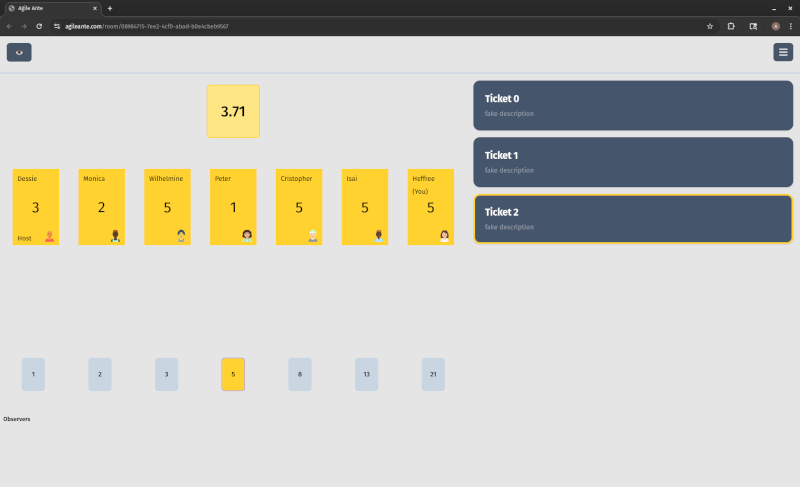
It's crazy that I've been working on this for 7 months — I counted and it was 43 days of those 7 months, but still. You can find the repo here: agile-ante
It's also not done. It's functional, but I had more planned for it. I'm just not having fun with it and I want to move on to something that aligns more with my interests.
What is Agile Ante?
Agile Ante is my incarnation of planning poker. Planning poker is a way of gamifying task effort estimation.
My team had been moving from planning poker site to planning poker site, mostly because all of them introduced some sort of paywall to have more than 5 tickets a day. It was generally a meme around the domain that we should make our own.
One week, we ended up having a hackathon. Our goal, we decided, was to teach our BA some coding and so we used planning poker as the teaching medium. We got almost nowhere, but we had fun and the BA learned a little more about what we do.
Fast forward a couple months and I decide I want to actually do it. I'll make the thing. By this point we had actually found Kollabe which is pretty fantastic and meets all of our needs. I thought "I'll create something that makes sure Kollabe stays fantastic", as a threat I guess?
So that's what I've been working on. My goal was to make it incredibly easy to distribute and spin up, but I didn't really make it to that point. I don't even have it dockerized.
What it do?
Agile Ante lets you create a room, with you as the host, by visiting any URL in the domain. If the room already exists, you instead join the room.
As host you can: add tickets, select a ticket to vote on, and flip votes.
As a player you can: vote or observe.
There's also little avatars provided through dicebear.
I really like that the client is embedded in the webserver executable, but the all-in-one kind of falls apart once you need persistence. I've jokingly thought about recompiling the executable every time state changes, but... yeah, that's not reasonable. Maybe I'll do that as a toy project someday.
I quit
It's completely functional and if I really wanted to I could probably get it across the finish line of "easily self-hostable", whatever that means in practice other than a docker image. I've hosted it myself, but will be taking that down.
But there's a bit more I wanted to do before even the packaging step and at this point it feels fruitless. There's a great product that exists and I don't really need to create a free alternative to compete, especially one where I can't realistically host the shared infrastructure and I instead expect it to be self-hosted. I looked into some P2P stuff, but it seemed messy and still costly.
Here's my remaining todo list:
[ ] URL Prefix Memory for tickets (use global state)
[ ] Comma separated list with a url prefix for quick ticket making
[ ] Graph showing votes
[ ] Make tabindexes perfect
[ ] Dark/Light
[ ] Clean up unwraps
[ ] Clean up React with proper hooks
[ ] Make it hostable (docs, conveniences)
[ ] Stop observers flipping lol
[ ] General polish
Simulation Testing
What I'm most proud of from this project is the simulation testing. I've played around with TigerBeetle's Simulation and have wanted to setup data simulation at my job to mimic a live environment. This was a nice opportunity to do some of that with my auto clients. It made development a lot more enjoyable and was a great way to demo to people. Click below to see them in action!
On to the next thing
Luckily I know what I want to work on next. I think it really aligns with not only the type of development I'm interested in, but also my favorite kind of software, and the type of "product" I want to be making. Can't wait! I'm sure it'll take years, but I'll do a little writeup on it next.
]]>Project: Personal Site + Bloghttps://heffree.dev/blog/project-personal-site-1.htmlAndrew Hessler2025-10-05T00:00:00+00:002025-10-05T00:00:00+00:00A rundown of what went into getting this blog up and running2025-10-05 |
Project: Personal Site + Blog
I created this blog for a few reasons:
I like writing (and typing).
I'm interested in participating in the conversation, being apart of the general programming zeitgeist.
I'd love to get feedback on both my programming and writing.
It's really a place for me to rubber duck and debrief, but I hope it can entertain and maybe even help others.
The rest of the personal site is there to direct people to my socials and stuff. I thought I would end up hosting some webapps on the same domain, but I'm not sure that'll be happening. On the same Linode pod, I host another personal site that my wife and I use for little throwaway tools.
Anyway, let's get into it!
The Stack
I've been using a pretty consistent stack since I started Planning Poker — which I'll do a post on in a little bit. That stack is:
Cloudflare domain (DNS only)
Linode pod
Nginx proxy
Rust webserver using axum
React client (embedded in the webserver executable)
Sqlite DB
And that's how this blog started as well. My Rust webserver serves both API routes and the files for the React client.
With this being just a simple blog, I immediately wanted to drop the React part and I have no current intentions of using a DB. I figured I'd just host some static files from my webserver and leave it at that.
I also don't really need any APIs, so why have the webserver at all? Nginx is a perfectly acceptable webserver, so I'll just use that. I may regret this a little as I think tracing might be a bit simpler if I had a personal webserver to tweak programmatically, but I'm also not pressed about it.
Where's the Rust?
But how can I live up to the Rust developer stereotypes if I don't try and shoehorn Rust into every project I ever touch?
Before I even got to work on my first real post, I was already getting frustrated with continuously find-and-replacing the nav — and that's on like 7 files. I deleted and readded the blog link every other day depending on how silly I felt having only a placeholder entry.
I've been following Armin Ronacher recently to observe his LLM playground. I'm pretty bearish on LLMs (from my personal experiences with them), but he seems like the person to keep an eye on if any breakthroughs do happen. Tangentially, I also know one of the things he's well-known for is the templating engine Jinja2 — but I don't want to use Python, I want to use Rust. I did browse his public source personal site for inspiration, though.
I also don't want to make my own templating engine, that's just not what I want to work on right now. Instead I reached for handlebars, but the Rust manifestation. Handlebars is something I've used, I just really can't remember when, which means it must've been at my first job or in college. All I remember is a lot of mustache discussion, which I'm incapable of growing.
Thus the webserver transformed into a static site generator.
Obsidian
Both the aesthetic design and technical implementation are motivated by my use of Obsidian. I wanted most of my site to be able to exist as markdown files and be rendered to html. There's a rust crate for that!
I've come to peace with my wanton importing of dependencies. I'm up to a total of 6 (and of course what they rely on); I'd argue anyhow, serde, and walkdir hardly count, but oh well. I'm a little sad about the potentially missed learning opportunities, but I can always go back. I'm going to continue to focus on the things that I see value in.
Implementation Wrap-up
That's where I'm at now:
Cloudflare domain (DNS Only)
Linode pod
Nginx webserver
Rust static site generator
a dist folder
The public source can be found here. I'll update the README with the nginx config. The nginx config started out pretty simple, but definitely got simpler after I stopped using it as a proxy.
I do some silly things with the generator. It's not structured well, but that's the benefit of building for yourself. I do multiple layers of template rendering, which interestingly is kind of similar to what we do at my current job with our Helm templating.
It was really satisfying to recognize some obvious over-engineering. And that over-engineering might even be valid for someone else's vision, it's really just about the tradeoffs. I might be over-engineered for someone else's vision. I just struggle to determine if any implementation is correct. Are all working implementations correct? I think yes. I also think depending on the context there can be more correct implementations.
I guess I feel better saying it was really satisfying to recognize such a distinct alternative architecture.
Design
As I mentioned earlier, one of my driving inspirations was Obsidian. I like the compressed area in the middle and it fits mobile well. I personally like the styling I have in Obsidian, but I think some people might see it as overkill. I may start to leak more of it into the site as time goes on.
For my second inspiration, I decided to use some toned down colors from my terminal colorschemes. The background of the site is the exact color of my terminal background, but the orange and cyan are adjacent to my tmux window split colors (X11 orange and cyan). They're pretty Portal inspired, but not the exact hexcodes.
Additional inspiration includes:
My nav looks egregiously similar to Colton Voege's, but maybe we can all just agree there's only so many ways to layout 5 elements and a horizontal rule/bottom border...
I noticed Martin Fowler calls his blog a "bliki", so I named my blog entry index "blikidex" as an homage. My wife informed me "bliky" is also slang for a gun nowadays, so that's fun. My actual content continues to reference it as a blog.
I also really like Nolen Royalty's EIEIO blog, I intend to eventually do something similar to him where my less relevant thoughts can be tossed off to the side; maybe anything that exists in parentheses.
I enjoy the simplicity of Nikhil Suresh's blog and I also now realize at one point my blog index looked identical to his, unintentionally.
I'm sure there is plenty of iteration to come, but for now this is where I'm at.
]]>More About Mehttps://heffree.dev/blog/about-me-continued.htmlAndrew Hessler2025-10-04T00:00:00+00:002025-10-04T00:00:00+00:00Just some additional information about me if you want it2025-10-04 |
More About Me
I guess this will be my first real blog post. I'm told I'm not actually the greatest writer who ever lived, so I'm going to cheat with my first entry and make it auto-biographical. Not too biographical, though... more self-referential? Just to say I'm not going to bother to write out my life story — I already did that in a draft.
ME
I'm a fairly transparent person. I do my best to be honest. Life is a lot easier that way.
I worry a lot. I guess you could spin that as I like to think things through, but it's definitely a balancing act of not spiraling. For example, as many people do, I have fake — or "preparatory" — conversations with myself. These usually end with me telling the "other person" that I have actually already thought about all of this, even this part where I'm telling them I thought about it and even that part, and so on, and so on. I'm working on it; it's going well.
Probably related to the worrying, I try my best to be considerate. I definitely don't want to be the source of someone's discomfort. I'd really prefer to be the source of their peace. Though, this is also something I'm trying to reign in. I have a list of sayings that have meaning for me and third on that list is "Not everyone has to like you."
Hobbies
It feels weird to describe the things I'm interested in as hobbies. I like learning. I want to be good at a lot of things. I'm currently bad at almost all of those things. I guess those are my hobbies.
Anyway, I want to know more about art, and be good at digital art — writing too. Ideally, I want to fuse digital art with programming. I've had drawing tablets and did some drawing as a kid, but I definitely was not, and am not, naturally talented at it and didn't really have the patience for things that didn't come easy. My wife is a great artist, though, so eventually I'll be able to take advantage of her taste.
I want to learn languages — Japanese, Korean, Spanish, and Arabic are on my insanely optimistic list. I've spent 2 years off-and-on studying Japanese. I worked through a list of 2200 basic Kanji, I have the entirety of a Rocket Languages course to get through, and I taught my wife to say "Tagetto wa doko desu ka" for if she ever needed to find a Target in Japan, of which none exist. Additionally, I learned some Spanish in middle school and high school, mostly getting C's. My college roommate was Palestinian... I used to know how to answer the phone and can no longer remember. Lastly, I just started listening to some more K-pop after seeing KPop Demon Hunters. Progress on all fronts!
Last of my learning crusade, programming. I love reading about programming. I love learning new programming languages, concepts, and technology. I love making things! It is my main craft and I'm lucky that it also gets to be my job — heck, I'm lucky to have a passion at all. Many people's passions are not necessarily financially viable as immediately as mine has been. I'm sorry we live in a world where a discussion regarding what we're most passionate about sharing leads to a weighing of if it can sustain us.
I also play video games. Overwatch mostly right now. Used to play League of Legends. I also enjoy coop games, single-player RPGs, etc. I watch TV, anime, and YouTube. I practice typing, switched to Colemak last year. I listen to all kinds of music. Eat good food, cook worse food. Play DnD. Love biking and swimming. And I'm not opposed to most other things!
Career
Last section! Wooooooooo, first blog!
I've had two professional software engineering jobs in my life up to this point.
The first job I worked on two separate stacks that powered two separate internal intranets that served various web apps. The first was a WIMP stack (Windows Server, IIS, MySQL, PHP) and the second was a WIMN stack (..., Microsoft SQL Server, Node). At this job I learned a lot of how and what, very little why. I wasn't doing great financially which made it very hard to pursue additional learning and be excited about programming while working nights at Taco Bell.
I did get to do some fun stuff, though, and I learned a lot about databases. Our first intranet was called VIC (Viking Internal Communication or something like that) and so we named the second VIC-N, for VIC-Node, which we then ended up calling Vixen. I made this fun logo! Which eventually got removed because it confused people... oh, we were a Coca-Cola distributor, by the way.
The second job (current job) came with a relatively ridiculous pay bump and I found a mentor that taught me to learn the how and what all on my own, which I now had plenty of time for. My time at this job really reignited all of my passion for learning. More recently, I've even had a mentee/coworker who has taught me to really introspect on the why. I get to work with so many different technologies and a lot of great people. I'm incredibly grateful for all of the experiences and opportunities pursuing this job has provided me.
]]>Time to start blogging!https://heffree.dev/blog/guess-i-blog-now.htmlAndrew Hessler2025-09-25T00:00:00+00:002025-09-25T00:00:00+00:00Opening dialogue2025-09-25 | misc
Time to start blogging!
Yup, so time to start blogging. I keep thinking I don't have much to say or I'm not necessarily confident in what I do have to say. Time to stop caring and start sharing, I guess lol
Placeholder Section Header
This is mostly a placeholder to test if I like my layout.